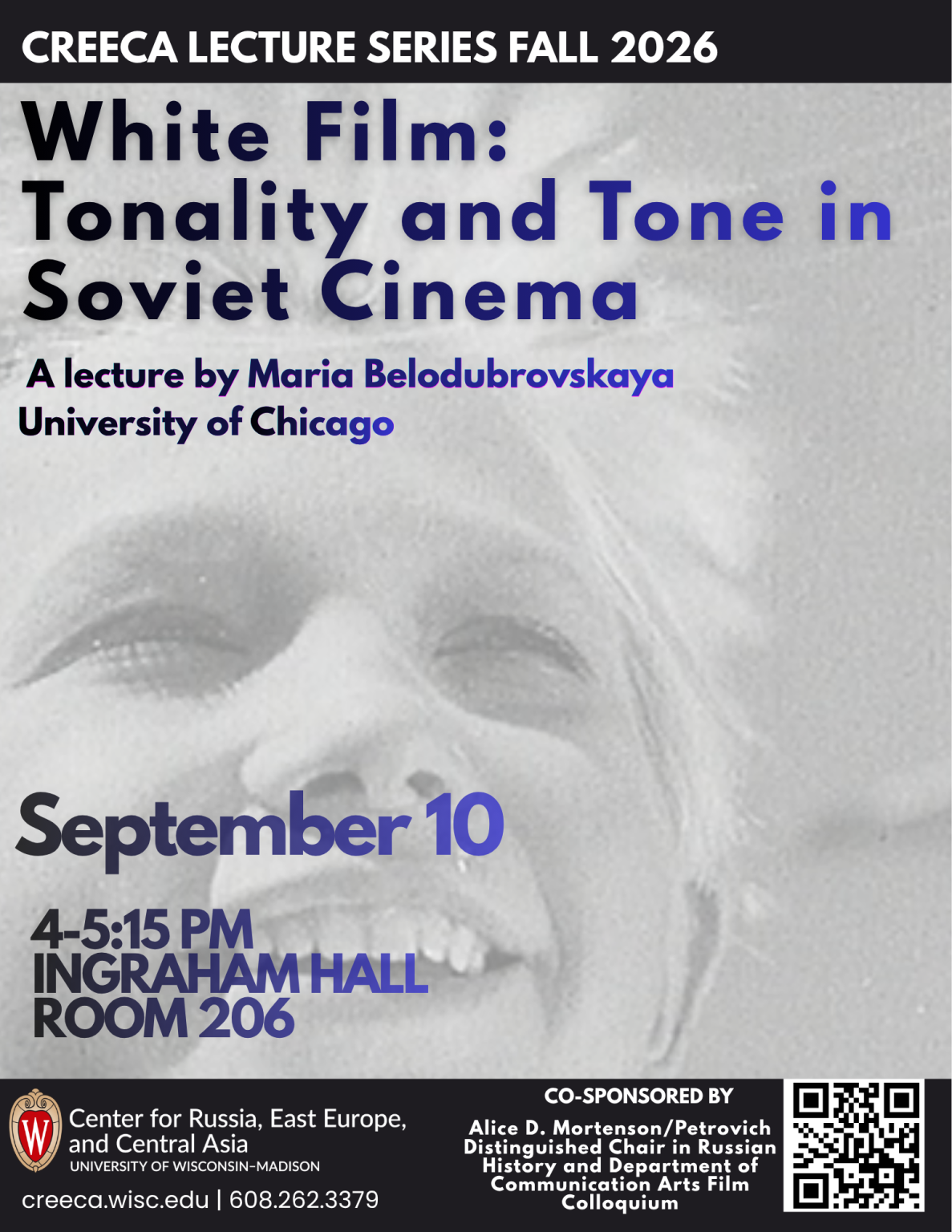
“White Film: Tonality and Tone in Soviet Cinema,” a lecture by Maria Belodubrovskaya
Maria Belodubrovskaya, University of Chicago
Ingraham 206
CREECA Event Page
This lecture is co-sponsored by the Alice D. Mortenson/Petrovich Distinguished Chair in Russian History and Department of Communication Arts Film Colloquium.
About the Lecture: When Soviet films were shown in the United States in the 1930s and 1940s, reviewers often complained about their slow tempo and propagandistic appeals but praised their acting and cinematography. Although since 1930 the Soviet film industry relied primarily on domestic film stock, and photography suffered as a result, the feature films that made it to the U.S. were of relatively high technical quality. One of the practices Soviet cinematographers developed to achieve crisper images was “white film”: filming white elements against white backgrounds using sunlight. This approach resulted in a strikingly bright look that distinguished Soviet films from those made in Hollywood, which was then developing a fashion for high-contrast cinematography that eventually resulted in film noir.
About the Speaker: Maria Belodubrovskaya is Associate Professor in the Department of Cinema and Media Studies at the University of Chicago. She is the author of Not According to Plan: Filmmaking under Stalin (2017) and has published works on Alfred Hitchcock, Sergei Eisenstein, Soviet cinema, and various issues in film aesthetics.