
SLAVIC COURSES FALL 2023
Featured Courses
(4 credits)
- Section 001: MTWRF 9:55-10:45 am
- Section 002 : MTWRF 11:00-11:50 am
- Section 003: MTWRF 12:05-12:55 pm
- Section 004: MTWRF 1:20-2:10 pm (TR ONLINE)
Course Description: Five hours a week focusing on speaking, listening, reading and writing Russian, with an introduction to Russian culture. No previous knowledge of Russian expected.
Prerequisites: None.
(4 credits)
- MTWR 11:00-11:50 am
Instructor: Krzystzof Borowski
Course Description: Introduction to Polish language focusing on speaking, listening, reading and writing with an introduction to Polish culture.
Prerequisites: None.
(4 credits)
- Section 001: MTWRF 11:00 – 11:50 am
- Section 002: MTWRF 1:20-2:10 pm
Course Description: Five hours a week focusing on speaking, listening, reading and writing Russian, with continued study of Russian culture.
Prerequisites: SLAVIC 102.
(4 credits)
- MTWR 11:00 – 11:50 am
Instructor: Krzysztof Borowski
Course Description: Development of speaking, listening, reading and writing skills in Polish, with continued study of Polish culture.
Prerequisites: SLAVIC 112.
(3 credits)
- TR 1:00 – 2:15 pm
Instructor: Lukasz Wodzynski
Course Description:
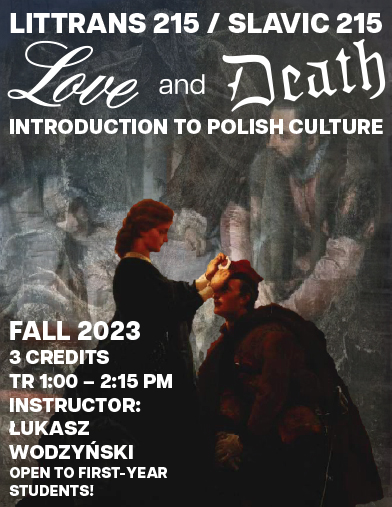
From medieval religious songs to twentieth-century modernist poems, Polish literature has always struggled with the fundamental mysteries of human existence, leaving in its trail unique tales of heroism, sacrifice, enchantment, despair, passion, and the redeeming power of love.
In this course, we will examine major traditions, narratives, and ideas that have shaped and defined Polish culture from its beginnings to the onset of World War II (1939). The course is designed to give you broad and contextualized knowledge of Polish culture by means of engaging you in careful readings of the source material. To unravel the dynamics of Polish culture, we will look at its four major paradigms – Christianity, Sarmatism, Romanticism, and Modernity – and their complex relationship over the course of centuries. While most of the material we will examine is historical in nature, we will always keep one eye on its continuing relevance, repeatedly asking the question of how Poland’s past shapes its present.
Prerequisites: None.
(Breadth: Literature, Humanities; Honors option available)
(4 credits)
- MTWR 12:05 – 12:55 pm
Instructor: David Danaher
Course Description: Description to come!
Prerequisites: None.
(3 credits)
- TR 11:00 am – 12:15 pm
Instructor: Kirill Ospovat
Course Description: Description to come!
Prerequisites: None.
(3 credits)
- MW 2:30 – 3:45 pm
Instructor: Oksana Stoychuk
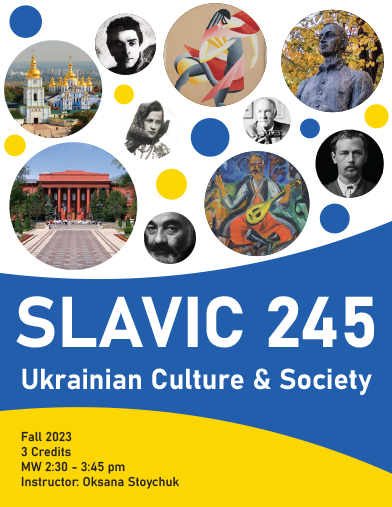
Course Description: In this course you will learn about Ukraine as a country with a unique ancient culture: Ukrainian Baroque architecture, universities dating back to 17th century, the first constitution developed in 1710, brilliant minds such as the philosopher Gregory Skovoroda (a true 18th-century hipster). You will learn about the literature and theatre of the Ukrainian avant-garde and the Executed Renaissance, a brutal extermination of Ukrainian intellectuals under Stalin, but also about Sofia Yablonska, a travel writer and photographer, who travelled around the world in the 1920s and 1930s and became one of the first women documentary cinematogaphers, about the Sixtiers, a generation of intellectuals and artists, one of whom, Sergej Parajanov, is seen by film historians as one of the most influential filmmakers in cinema history, about feminist art and activism from the beginning of the 1990s and much more. By the end of this course, you will not only know that the well-known Christmas song “Carol of the Bells” was composed by the Ukrainian composer Mykola Leontovych or that the first helicopter was built by the Ukrainian engineer Igor Sikorsky. You will be exposed to a unique intellectual tradition that has shaped our shared past and is shaping the global present.
(3 credits)
- TR 2:30 – 3:45 pm
Instructor: Lukasz Wodzynski
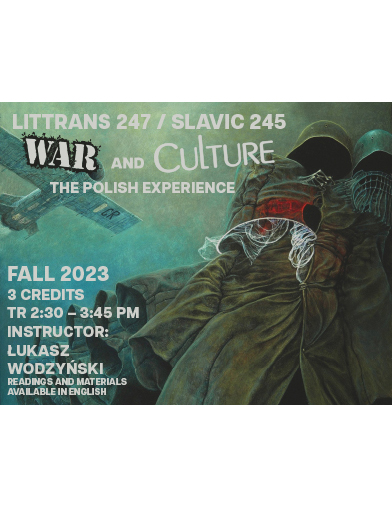
Course Description: Poland and Europe 1914-1945. Even as we emerge from a devastating global health crisis and face the uncertain future, with the world on the edge, we find that the traumas, issues, and concepts engendered by two World Wars continue to haunt us, even a century later. We once again find ourselves in difficult times, marked by social, cultural, religious, and economic tensions. In this course, we will examine how cultural texts – including literature, film, theatre, painting, and sculpture – produced during, between, and after the two wars – deal with the extreme and everyday experiences, with shattered worlds of individuals, ethnicities, and nations. This course concentrates on 20th -century Polish culture. All the readings and materials are available in English.
Prerequisites: None.
(Breadth: Literature, Humanities; Honors option available)
(3 credits)
Instructor: Alexandra Walter
Course Description: A thorough review of several major aspects of Russian grammar, focusing on the use of complex syntax in speech and writing. Read and discuss literary works and other Russian-language texts. Students will develop writing proficiency through compositions on a variety of topics.
Prerequisites: SLAVIC 118 or 204.
(3 credits)
Instructor: Krzysztof Borowski
Course Description: In this course, students explore both traditional and evolving notions of culture in Poland, review grammar, and build vocabulary related to the cultural topics studied. The course has a strong emphasis on reading and speaking. The reading assignments are based on short stories, press articles, poetry, and a novel. Assignments will contain discussion questions, reading/listening comprehension activities, lexical, and grammar exercises.
Prerequisites: SLAVIC 208.
(3 credits)
Instructor: Krzysztof Borowski
Course Description: In this course, students explore both traditional and evolving notions of culture in Poland, review grammar, and build vocabulary related to the cultural topics studied. The course has a strong emphasis on reading and speaking. The reading assignments are based on short stories, press articles, poetry, and a novel. Assignments will contain discussion questions, reading/listening comprehension activities, lexical, and grammar exercises.
Prerequisites: SLAVIC 277.
(3 credits)
Instructor: Ewa Miernowska
Course Description:
This course provides an introduction to the fundamental concepts of the Polish language, including basic vocabulary and grammar. Students will gain practical skills in speaking, listening, reading, and writing, while also being introduced to the culture of Poland. The focus is on building proficiency in the language, with an emphasis on practical usage. This intensive course covers the material of three regular semesters in just one semester. Whether the student is a complete beginner or has some prior exposure to the language, he/she will find that the class moves at a comfortable pace and provides plenty of support and guidance along the way. Can be an excellent choice for Polish heritage students who need to review their grammar before taking more advanced courses.
Prerequisites: Open for all levels including Freshmen. No prior knowledge of the Polish language is required for this class.
(L&S Credit – Counts as Liberal Arts and Science credit in L&S)
(3 credits)
Instructor: Krzysztof Borowski
Course Description: In this course, students explore both traditional and evolving notions of culture in Poland, review grammar, and build vocabulary related to the cultural topics studied. The course has a strong emphasis on reading and speaking. The reading assignments are based on short stories, press articles, poetry, and a novel. Assignments will contain discussion questions, reading/listening comprehension activities, lexical, and grammar exercises.
Prerequisites: Slavic 304.
(3 credits)
Instructor: Krzysztof Borowski
Course Description: In this course, students explore both traditional and evolving notions of culture in Poland, review grammar, and build vocabulary related to the cultural topics studied. The course has a strong emphasis on reading and speaking. The reading assignments are based on short stories, press articles, poetry, and a novel. Assignments will contain discussion questions, reading/listening comprehension activities, lexical, and grammar exercises.
Prerequisites: Slavic 305.
(3 credits)
- TR 1:00 – 2:15 pm
Instructor: Anna Tumarkin
Course Description: Description to come!
Prerequisites: None.
(4 credits)
- MWF 1:20-2:10 pm
Instructor: Sara Karpukhin
Course Description: This course will focus on development of all four skills (reading, writing, speaking, and listening) in the interpretative (interpreting written and audio/video materials), interpersonal (speaking with others), and presentational (oral presentations to the class and written compositions) modes. The title of the textbook we will be using, Kagan et al.’s Russian: from Intermediate to Advanced, reflects the course goal: to enable students to progress in language proficiency from the Intermediate to the Advanced level in reading and listening, and to the Intermediate High level in speaking and writing. In addition, the course will enrich students’ cultural knowledge through reading and discussion of classical literary texts from Rosengrant’s The Golden Age.
Prerequisites: SLAVIC 276.
(3 credits)
Instructor: Krzysztof Borowski
Course Description: In this course, students explore both traditional and evolving notions of culture in Poland, review grammar, and build vocabulary related to the cultural topics studied. The course has a strong emphasis on reading and speaking. The reading assignments are based on short stories, press articles, poetry, and a novel. Assignments will contain discussion questions, reading/listening comprehension activities, lexical, and grammar exercises.
Prerequisites: Slavic 278.
(3 credits)
Instructor: Krzysztof Borowski
Course Description: In this course, students explore both traditional and evolving notions of culture in Poland, review grammar, and build vocabulary related to the cultural topics studied. The course has a strong emphasis on reading and speaking. The reading assignments are based on short stories, press articles, poetry, and a novel. Assignments will contain discussion questions, reading/listening comprehension activities, lexical, and grammar exercises.
Prerequisites: Slavic 331.
(3 credits)
- TR 2:30 – 3:45 pm
Instructor: Kirill Ospovat
Course Description: The course will explore the dual political face of Enlightenment, turned at once towards sovereignty and democracy, freedom and governance, revolution and enslavement. We will discuss these topics in the context of global Enlightenments, with a specific focus on Russia, tracing them through the works of philosophers (Francis Bacon, Immanuel Kant), social critics (Guillaume Raynal, Aleksandr Radischev), monarchs, republicans, and freed slaves.
(3 credits)
- MWF 12:05-12:55 pm
Instructor: Sara Karpukhin
Course Description: The primary aim of the course, the first one in a two-course sequence, is to offer an overview of those aspects of Russian history and culture which are most relevant in Russia today. The course will include a survey of the most important historical events of Russian history up to the end of the 18th century. The goal is to introduce you to the discussion of Russian culture in Russian, but the instructor will only occasionally correct your grammar in conversation, when your meaning is not communicative. We will continually practice all four skills (listening, reading, speaking, writing), but always in application to historical and cultural knowledge.
Prerequisites: SLAVIC 321.
(3 credits)
- MTWR 12:05-12:55 pm
Instructor: David Danaher
Course Description: Description to come!
(3 credits)
- M 2:30 – 5:00 pm
Instructor: Maksim Hanukai
Course Description: This course introduces students to Russian Romanticism and provides them with a solid foundation in both primary texts and secondary scholarship in the field.
Prerequisites: Graduate or professional student.
(1 credits)
- R 2:30 – 4:00 pm
Instructor: Anna Tumarkin
Course Description: Description to come!
(1 credits)
- W 2:30 – 5:00 pm
Instructor: Maksim Hanukai
Course Description: This course introduces students to Russian Romanticism and provides them with a solid foundation in both primary texts and secondary scholarship in the field.
Prerequisites: Graduate or professional student.
(1-credit; tied to Slavic 703; meets 5 times during the semester)