Slavic Courses – Fall 2026
Featured Courses
(4 Credits)
- Lecture 001: MTWRF 8:50 – 9:40 am
- Lecture 002: MTWRF 9:55 – 10:45 am
- Lecture 003: MTWRF 12:05 – 12:55 pm
- Lecture 004: MTWRF 1:20 – 2:10 pm
Instructor: Anna Tumarkin
Course Description: Five hours a week focusing on speaking, listening, reading and writing Russian, with an introduction to Russian culture. No previous knowledge of Russian expected.
Prerequisites: None.
(4 Credits)
- Lecture 001: MTWR 11:00 – 11:50 am
Instructor: Oksana Stoychuk
Course Description: Introduction to Polish language focusing on speaking, listening, reading and writing with an introduction to Polish culture.
Prerequisites: None.
(4 Credits)
- Lecture 001: MTWRF 9:55 – 10:45 am
- Lecture 002: MTWRF 12:05 – 12:55 pm
Instructor: Anna Tumarkin
Course Description: Five hours a week focusing on speaking, listening, reading and writing Russian, with continued study of Russian culture.
Prerequisites: SLAVIC 102.
(4 Credits)
- Lecture 001: MTWR 12:05 – 12:55 pm
Instructor: Krzysztof Borowski
Course Description: Development of speaking, listening, reading and writing skills in Polish, with continued study of Polish culture.
Prerequisites: SLAVIC 112.
(Meets with GNS 370)
(3 Credits)
- Lecture 001: TR 1:00 – 2:15 pm
(3 Credits)
- Lecture 001: TR 2:30 – 3:45 pm
Instructor: Łukasz Wodzyński
Course Description: What constitutes heroism in the absence of universally shared moral frameworks? Who are we as individuals? What responsibility do we have for the way we represent reality to ourselves and to others? What constitutes “good life”? Engage with these questions and examine Polish cinematic tradition from the Polish Film School to the present. Explore key works, themes, and creators of Polish cinema, and probe the ethical and existential dimensions these films open up.
Prerequisites: None
(3 Credits)
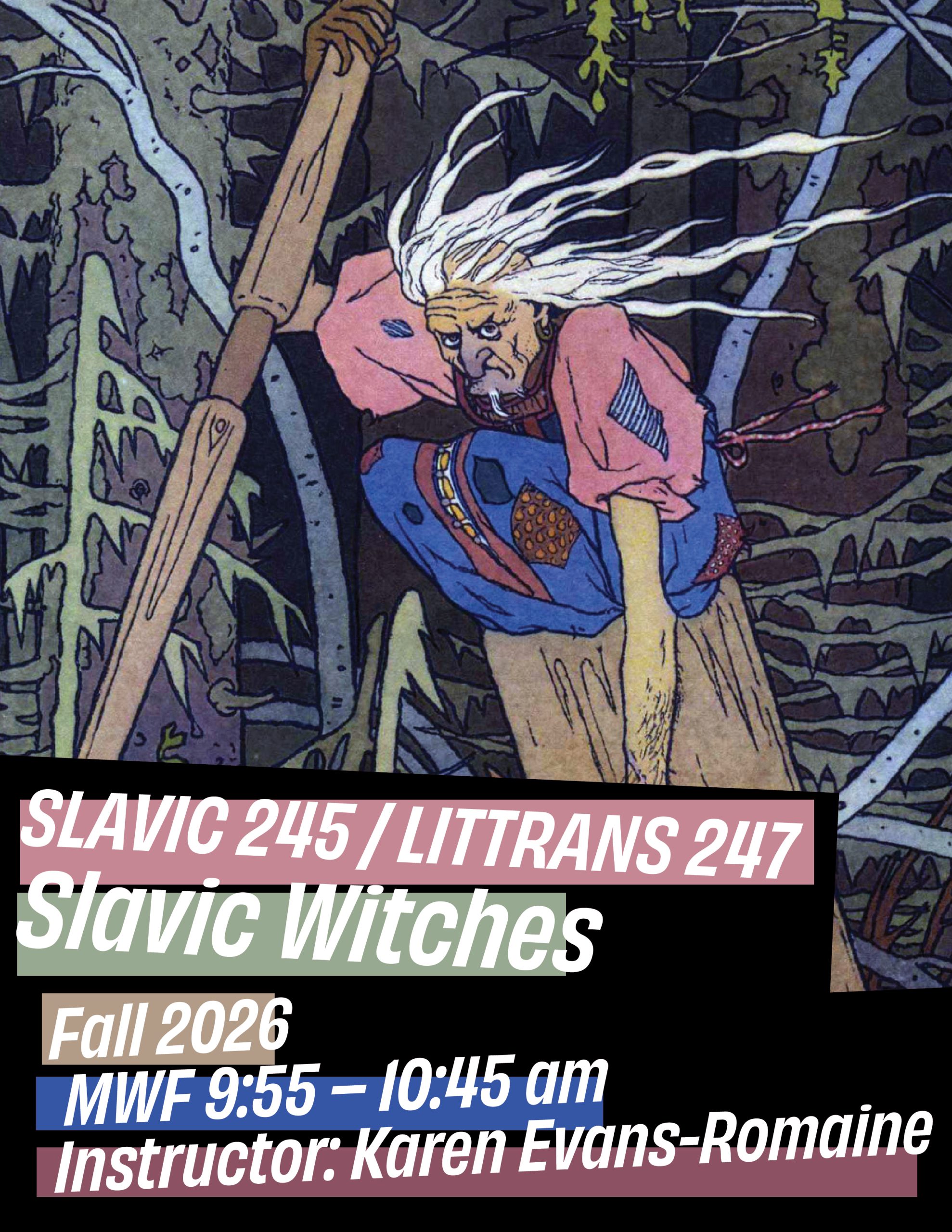
- Lecture 001: MWF 9:55 – 10:45 am
Instructor: Karen Evans-Romaine
Course Description: Who is a witch? Who decides? What do Slavic and East European witches do? Where and how do they live? How did they become witches? In this course we will explore images of Slavic and East European witches in fairytales, literature, the visual arts, music, and film in their cultural, historical, and political contexts.
(3 Credits)
- Lecture 001: TR 9:30 – 10:45 am
Instructor: Oksana Stoychuk
Course Description: This course is designed to introduce students to the fascinating world of Ukrainian culture from pre-Christian times to the present day. We will examine a number of cultural facets that help create Ukraine: history, folklore, language, art, literature, music, as well as current situation in Ukraine. We will learn how to tell fortunes with hot wax and what visual poetry means; we will learn the most popular Ukrainian (and American) Christmas carol and we will explore linguistic and historical nuances, which will help us embrace Ukrainian culture and history. All required texts are in English. In addition to the readings, we will include a variety of sources such as films, art works, cartoons and music.
Prerequisites: None
(3 Credits)
- Lecture 001: TR 1:00 – 2:15 pm
Instructor: Łukasz Wodzyński
(3 Credits)
- Lecture 001: MWF 8:50 – 9:40 am
Instructor: Alexandra Walter
Course Description: A thorough review of several major aspects of Russian grammar, focusing on the use of complex syntax in speech and writing. Read and discuss literary works and other Russian-language texts. Students will develop writing proficiency through compositions on a variety of topics.
Prerequisites: SLAVIC 118 or 204.
(3 Credits)
- Lecture 001: MWF 8:50 – 9:40 am
Instructor: Krzysztof Borowski
Course Description: In this course, students explore both traditional and evolving notions of culture in Poland, review grammar, and build vocabulary related to the cultural topics studied. The course places a strong emphasis on speaking and reading. Reading assignments include short stories, press articles, poetry, and a novel. Additionally, the program incorporates films, music, and visual arts.
Open to Freshmen
Contact Krzysztof Borowski (borowski3@wisc.edu) or Joanna Schuth (jschuth@wisc.edu), with any questions about the course or appropriate placement.
Prerequisites: Slavic 208 or a placement test. Contact Krzysztof Borowski (borowski3@wisc.edu) or Joanna Schuth (jschuth@wisc.edu) for placement test
(3 Credits)
- Seminar 001: TR 4:00 – 5:15 pm
Instructor: David Danaher
Course Description: Do languages shape the way we think? For bicultural individuals, the answer to this question is obviously yes. Even, however, for students who have attained an intermediate- or advanced-level proficiency in another language, the idea that languages present different “pictures of the world” – that language and worldview often go hand-in-hand – seems self-evident. Indeed, questions of cross-linguistic differences about the meanings of words and concepts (does French s’amuser bien have the same meaning as English to have fun?) could be said to represent more clear-cut and stark cases of similar questions of meaning within one language (is my idea of fun really the same as yours?). Language does, in a very real way, represent a certain “picture of the world”. If differences in how languages convey meaning exist, then it should certainly be possible to develop a framework for reflecting on these “linguistic pictures of the world”. This course represents both an introduction to semantic analysis (how do languages encode meaning?) as well as a content-based course in comparative ethnosemantics (to what extent does language shape the way we think and how can we systematically investigate this question?). Cross-linguistic case studies of the meanings of terms and concepts – everyday words like home, modes of conveying spatial orientation, words relating to human psychology – will serve as practical vehicles for an explanation and a discussion of the theory of a cultural approach to semantics. In addition to this, evidence for the encoding of culture in grammatical constructions and in discourse will be introduced. We will also examine the consequences of a cultural approach to language for reading and interpreting literature. This course requires no formal background in linguistics. The course lies at the intersection of humanities proper and social sciences. One of its primary goals is to hone critical-thinking skills related to language and culture that should prove relevant to any number of academic disciplines (literature, psychology, history, political science, philosophy, anthropology, sociology, communications, education, human geography) as well as to everyday self-understanding. Please note: this is an Honors-level course.
Prerequisites: This is an Honors-only course but students not in the Honors program may be allowed in with permission of the instructor.
(3 Credits)
- Lecture 001: MWF 8:50 – 9:40 am
Instructor: Krzysztof Borowski
Course Description: The aim of the course is to help students to extend their knowledge of the language, as well as to enhance their literacy skills, and cultural awareness. Class activities are largely based on contemporary Polish prose and on articles from the Polish press related to contemporary Polish society. Students expend their vocabulary by engaging with texts from different genres, historical periods and perspectives. The syllabus includes working on grammar with written exercises and compositions. The course has a strong emphasis on speaking. Students work in groups, make presentations, and debate different issues in class discussions. A study of Polish culture is offered also through films, music and media.
Prerequisites: Slavic 204 OR placement test for other students including Freshmen.
(L&S Credit – Counts as Liberal Arts and Science credit in L&S. Counts for the Slavic Certificate)
(3 Credits)
- Lecture 001: MWF 8:50 – 9:40 am
Instructor: Krzysztof Borowski
Course Description: In this course, students explore both traditional and evolving notions of culture in Poland, review grammar, and build vocabulary related to the cultural topics studied. The course has a strong emphasis on reading and speaking. The reading assignments are based on short stories, press articles, poetry, and a novel. Assignments will contain discussion questions, reading/listening comprehension activities, lexical, and grammar exercises.
Prerequisites: Slavic 305.
(3 Credits)
- Lecture 001: TR 1:00 – 2:15 pm
Instructor: Anna Tumarkin
Course Description: Emphasizes speaking and listening skills, helping students to converse on different stylistic levels, with varying degrees of formality, according to the rules of Russian speech etiquette.
Prerequisites: SLAVIC 118 or SLAVIC 204.
(3 Credits)
- Lecture 001: MWF 9:55 – 10:45 am
Instructor: Sara Karpukhin
Course Description: This course will focus on development of all four skills (reading, writing, speaking, and listening) in the interpretative (interpreting written and audio/video materials), interpersonal (speaking with others), and presentational (oral presentations to the class and written compositions) modes. The title of the textbook we will be using, Kagan et al.’s Russian: from Intermediate to Advanced, reflects the course goal: to enable students to progress in language proficiency from the Intermediate to the Advanced level in reading and listening, and to the Intermediate High level in speaking and writing. In addition, the course will enrich students’ cultural knowledge through reading and discussion of classical literary texts from Rosengrant’s The Golden Age.
Prerequisites: SLAVIC 276.
(3 Credits)
- Lecture 001: MWF 8:50 – 9:40 am
Instructor: Krzysztof Borowski
Course Description: In this course, students explore both traditional and evolving notions of culture in Poland, review grammar, and build vocabulary related to the cultural topics studied. The course places a strong emphasis on speaking and reading. Reading assignments include short stories, press articles, poetry, and a novel. Additionally, the program incorporates films, music, and visual arts.
Open to Freshmen
Contact Krzysztof Borowski (borowski3@wisc.edu) or Joanna Schuth (jschuth@wisc.edu), with any questions about the course or appropriate placement.
Prerequisites: Slavic 208 or a placement test. Contact Krzysztof Borowski (borowski3@wisc.edu) or Joanna Schuth (jschuth@wisc.edu) for placement test
(3 Credits)
- Lecture 001: MWF 8:50 – 9:40 am
Instructor: Krzysztof Borowski
Course Description: In this course, students explore both traditional and evolving notions of culture in Poland, review grammar, and build vocabulary related to the cultural topics studied. The course places a strong emphasis on speaking and reading. Reading assignments include short stories, press articles, poetry, and a novel. Additionally, the program incorporates films, music, and visual arts.
Open to Freshmen
Contact Krzysztof Borowski (borowski3@wisc.edu) or Joanna Schuth (jschuth@wisc.edu), with any questions about the course or appropriate placement.
Prerequisites: Slavic 208 or a placement test. Contact Krzysztof Borowski (borowski3@wisc.edu) or Joanna Schuth (jschuth@wisc.edu) for placement test
(3 Credits)
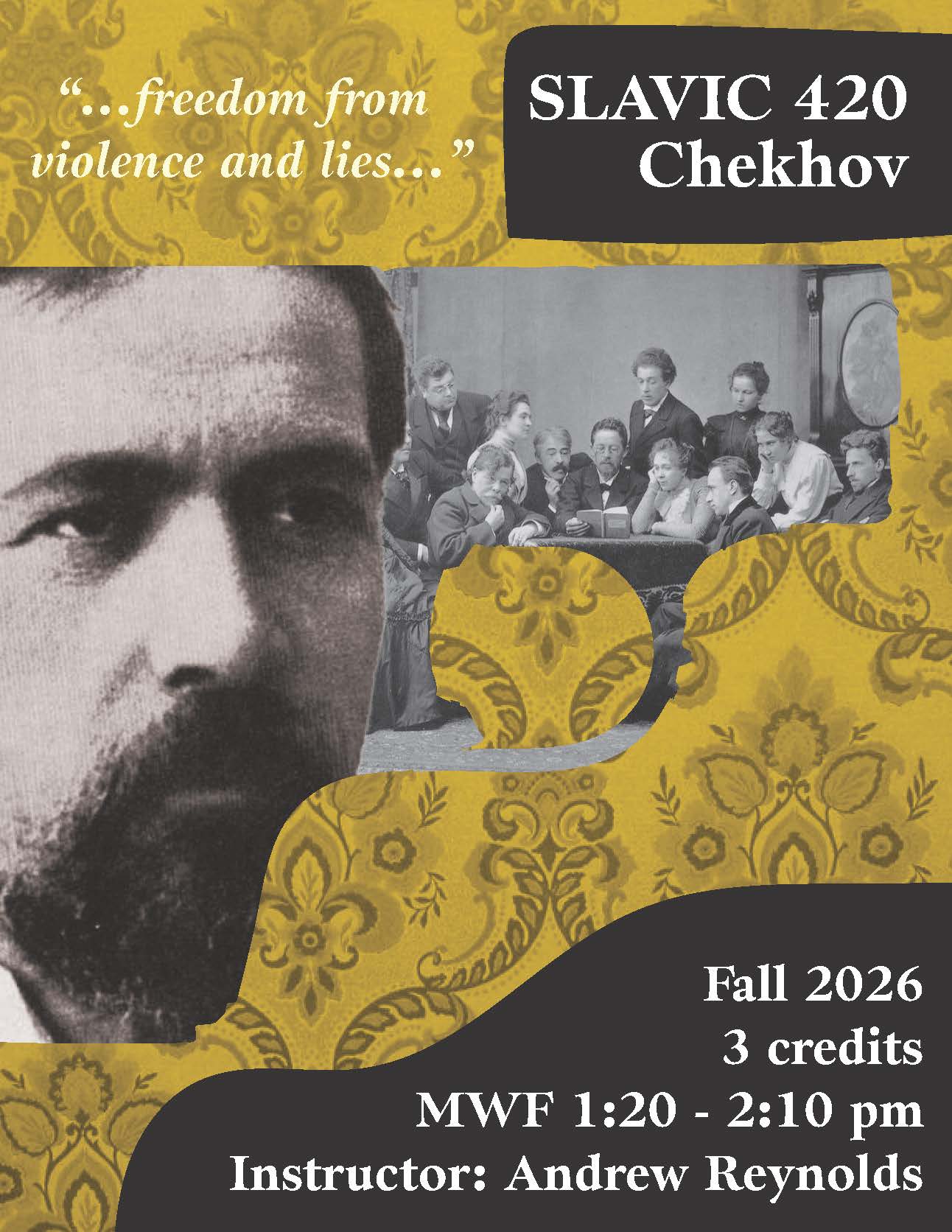
- Lecture 001: MWF 1:20 – 2:10 pm
Instructor: Andrew Reynolds
Course Description: This course introduces students to the life and works of Anton Chekhov (1860-1904). Through close reading and discussion of his short stories, novellas, and plays, students will learn about Chekhov’s treatment of such topics as childhood, religion, love and infidelity, death, mental illness, colonial expansion and the manifold dramas of modern life, while paying close attention to his developing artistic views and literary technique. All readings will be in English.
Prerequisites: None
(3 Credits)
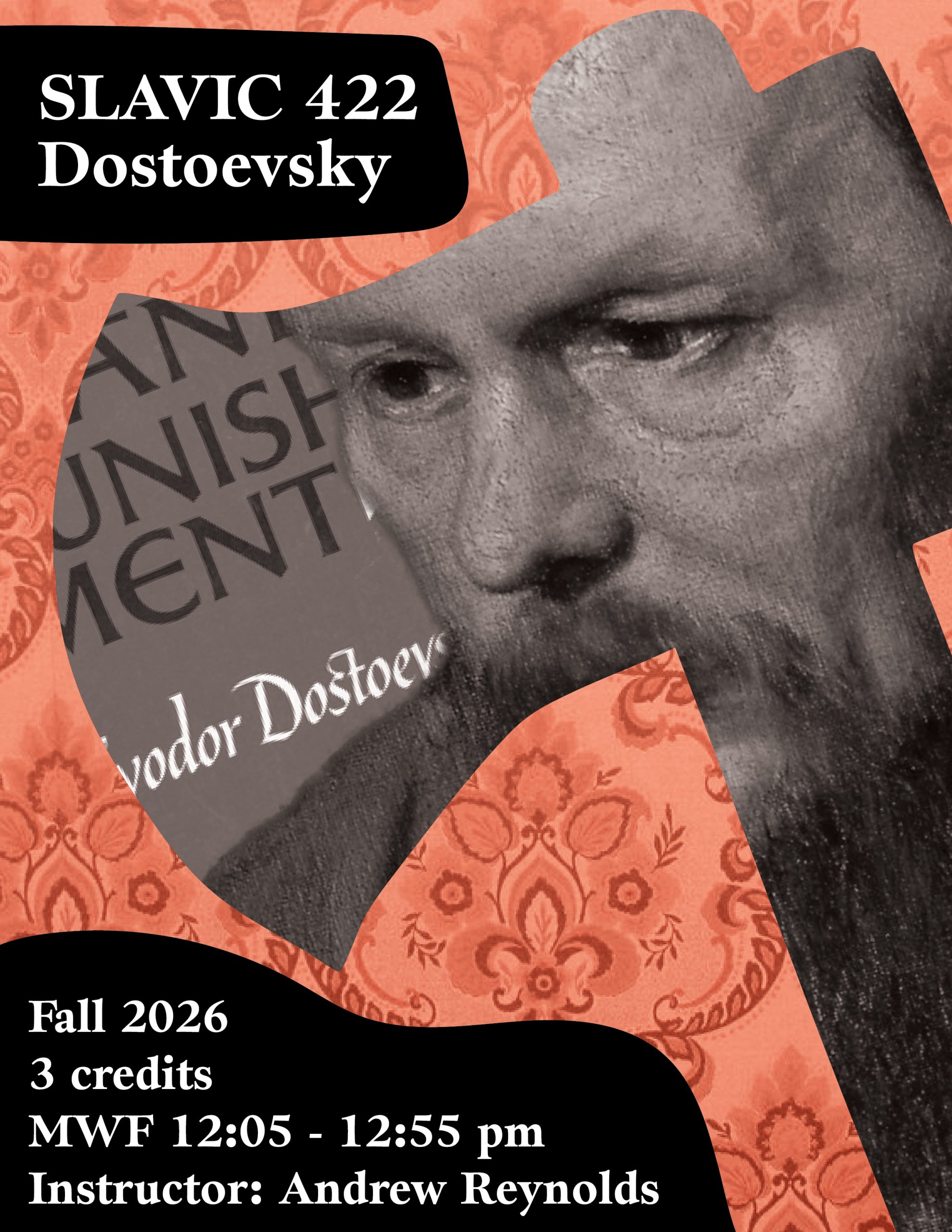
- Lecture 001: MWF 12:05 – 12:55 pm
Instructor: Andrew Reynolds
Course Description: Fyodor Mikhailovich Dostoevsky (1821-1881) is generally considered to be one of the greatest novelists in world literature. His insights into human psychology and his analysis of the political and spiritual climate of 19th-century Russia (and of European thought more broadly) have influenced many major writers and philosophers, from Freud and Nietzsche to Faulkner and Camus. We will survey Dostoevsky’s work as a whole, but our main focus will be on the seminal Notes from Underground, one of the most important proto-existentialist works, and above all on two of Dostoevsky’s greatest novels: Crime and Punishment and The Brothers Karamazov. Crime and Punishment is perhaps the most accessible of all Dostoevsky’s works and develops the critique of rationalism and utilitarianism begun in Notes from Underground and continued in later novels. Dostoevsky’s masterpiece, The Brothers Karamazov, foretells the rise of totalitarianism, provides particularly revealing insights into human psychology and sexuality, and is the culminating expression of his religious and political thought, an ambiguous legacy that makes Dostoevsky very much our contemporary.
(3 Credits)
- Lecture 001: MWF 12:05 – 12:55 pm
Instructor: Sara Karpukhin
Course Description: The primary aim of the course, the first one in a two-course sequence, is to offer an overview of those aspects of Russian history and culture which are most relevant in Russia today. The course will include a survey of the most important historical events of Russian history up to the end of the 18th century. The goal is to introduce you to the discussion of Russian culture in Russian, but the instructor will only occasionally correct your grammar in conversation, when your meaning is not communicative. We will continually practice all four skills (listening, reading, speaking, writing), but always in application to historical and cultural knowledge.
Prerequisites: SLAVIC 321.
(3 Credits)
- Seminar 001: TR 9:30 – 10:45 am
Instructor: Irina Shevelenko
Course Description: This seminar will introduce students to the more advanced study of Russian literature and culture through the close examination of four works of fiction that use distinct historical settings: Alexander Pushkin’s Kapitanskaia dochka, Fazil Iskander’s “Piry Valtasara,” Vasily Grossman’s “V gorode Berdicheve,” and Liudmila Ulitskaya’s “Dar nerukotvornyi.” We will also watch film adaptations of Iskander’s and Grossman’s works. We will analyze the linguistic and literary aspects of texts, learn about their cultural and historical contexts, and discuss the relations between literary works and film adaptations. All readings, materials, and discussions will be in Russian.
(3 Credits)
- Lecture 001: M 2:30 – 5:00 pm
Instructor: Kirill Ospovat
Course Description: This course introduces students to Russian Romanticism and provides them with a solid foundation in both primary texts and secondary scholarship in the field.
Prerequisites: Graduate or professional student.
(3 Credits)
- Seminar 001: R 1:00 – 2:15 pm
Instructor: Irina Shevelenko
Course Description: The purpose of this course is three-fold: 1) an introduction to literary studies as a field and to research methods in literary studies; 2) an introduction to the faculty in our program; 3) an introduction to the field of Slavic studies in general and its institutional structure and functioning in the US in particular. On Slavic faculty presentation days, each faculty member will talk about his/her research interests and his/her vision of our academic field, as well as cover other topics specified in the syllabus.
Prerequisites: Graduate or professional standing.
(3 Credits)
- Lecture 001: MW 11:00 – 11:50 am
Instructor: Karen Evans-Romaine
Course Description: This course will address some models of adult second language acquisition and language instruction, methods for teaching Russian, lesson and course design, language proficiency assessment, formative and summative assessments, and criteria for the selection of pedagogical materials.
Prerequisites: Graduate-level course; graduate standing.
(This course is required for graduate student TAs teaching Russian language courses.)
(3 Credits)
- Lecture 001: R 2:30 – 4:00 pm
Instructor: Anna Tumarkin
Course Description: This course is designed and required for current Slavic Department Russian-language Teaching Assistants and provides important professional development in course design, lesson planning, and assessment. Course participants work cooperatively to develop course activities and assessment instruments, and will learn how to identify and solve problems in the classroom.
Prerequisites: Consent of instructor.
(3 Credits)
- Seminar 001: T 2:30 – 5:00 pm
Instructor: Irina Shevelenko
(3 Credits)
- Seminar 001: W 2:30 – 5:00 pm
Instructor: Kirill Ospovat
Course Description: This course introduces students to Russian Romanticism and provides them with a solid foundation in both primary texts and secondary scholarship in the field.
Prerequisites: Graduate or professional student.