Catastrophic Belatedness (Celan, Darwish, Derrida)
Peter Makhlouf
Ingraham 206
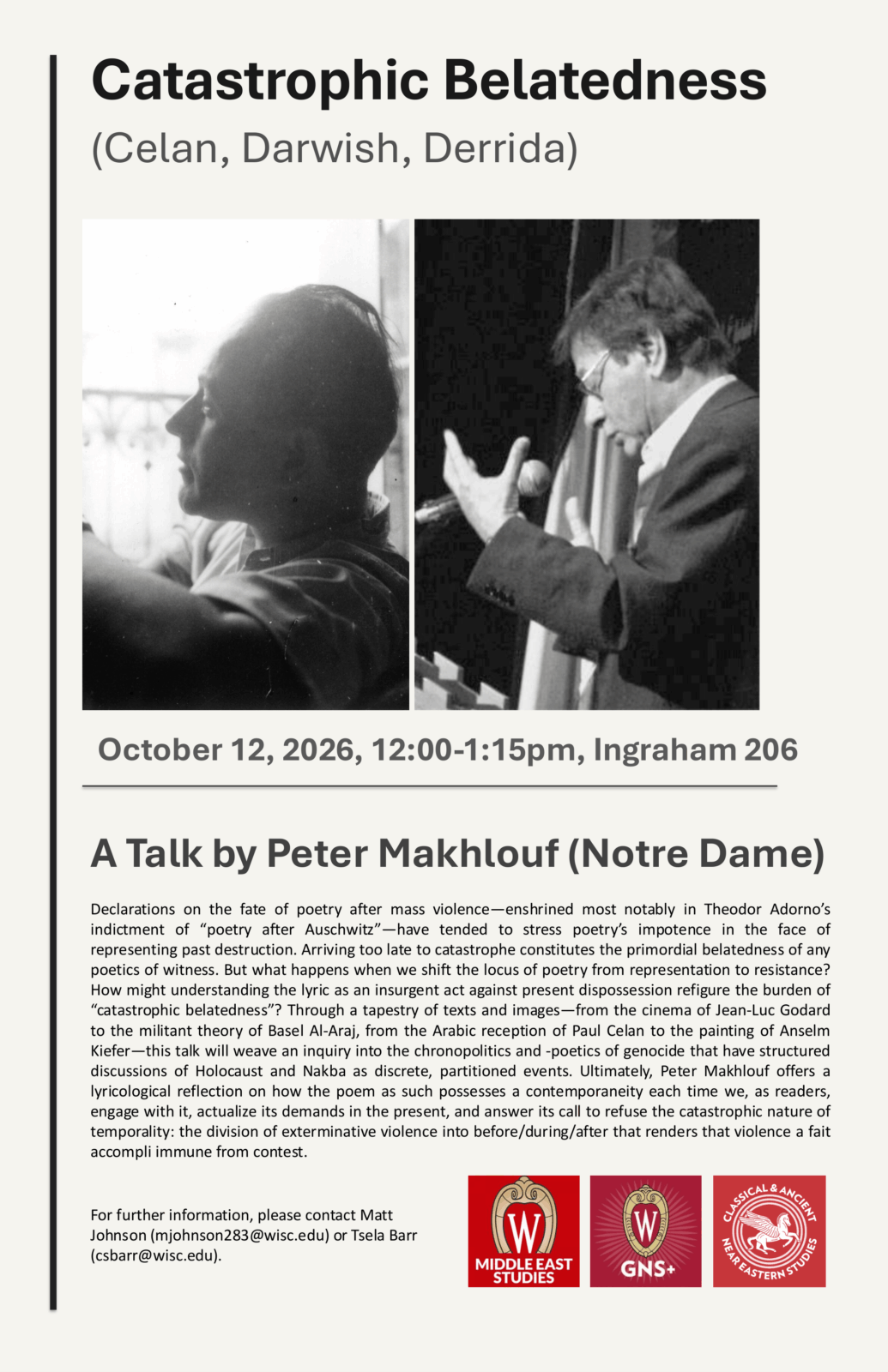
Declarations on the fate of poetry after mass violence—enshrined most notably in Theodor Adorno’s indictment of “poetry after Auschwitz”—have tended to stress poetry’s impotence in the face of representing past destruction. Arriving too late to catastrophe constitutes the primordial belatedness of any poetics of witness. But what happens when we shift the locus of poetry from representation to resistance? How might understanding the lyric as an insurgent act against present dispossession refigure the burden of “catastrophic belatedness”? Through a tapestry of texts and images—from the cinema of Jean-Luc Godard to the militant theory of Basel Al-Araj, from the Arabic reception of Paul Celan to the painting of Anselm Kiefer—this talk will weave an inquiry into the chronopolitics and -poetics of genocide that have structured discussions of Holocaust and Nakba as discrete, partitioned events. Ultimately, Peter Makhlouf offers a lyricological reflection on how the poem as such possesses a contemporaneity each time we, as readers, engage with it, actualize its demands in the present, and answer its call to refuse the catastrophic nature of temporality: the division of exterminative violence into before/during/after that renders that violence a fait accompli immune from contest.
Lunch will be served at the talk. All are welcome, but if possible, please register in advance if you plan to attend.
Hosted by the Middle East Studies Program and co-sponsored by the German+ program.
For further information, please contact Matt Johnson (mjohnson283@wisc.edu) or Tsela Barr (csbarr@wisc.edu).
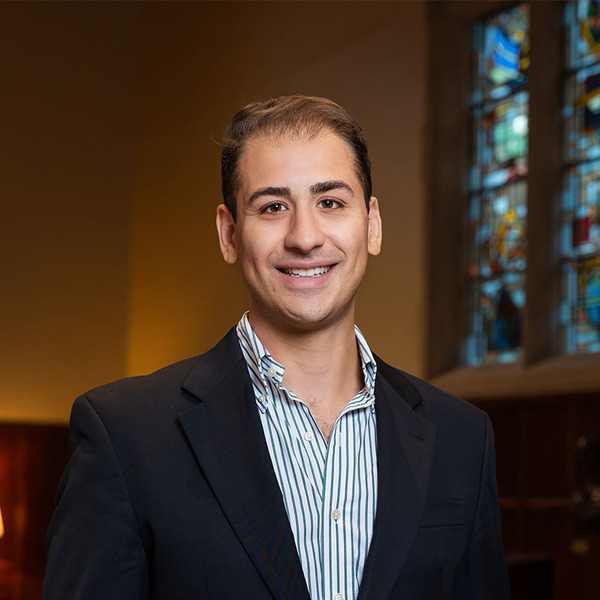
Peter Makhlouf is the Provost’s Postdoctoral Fellow in the Department of German, Slavic and Eurasian Studies at the University of Notre Dame. He has published on topics ancient, medieval and modern in a range of scholarly venues, while his public writing has appeared in fora including Jewish Currents, Frankfurter Allgemeine Zeitung, and boundary2online. He has currently at work on two books: one on culture and imperialism in the poetry of Stefan George, the other on catastrophic poetics between Germany and Palestine.