Polish Studies Students Earn Prestigious Fulbright Awards to Teach in Poland
The UW–Madison Polish Studies program is excited to announce that two of our former students, Hania Dahms and Elena Tomchek, have been awarded scholarships through the Fulbright English Teaching Assistant (ETA) Program and will teach English in Poland during the 2026–27 academic year. To learn more about their experiences and aspirations, we interviewed Elena and Hania about their motivations for applying to the program, why they chose Poland, and the role that UW–Madison’s Polish language and culture courses played in their journeys.
Why did you apply to the Fulbright English Teaching Assistant (ETA) Program, and how did you first learn about this opportunity?
Elena: I applied to the Fulbright ETA Program because I enjoyed tutoring organic chemistry and teaching general chemistry during my undergraduate studies. During my search for programs in Poland, I came across Fulbright and found that it aligned perfectly with both my aspirations to teach and my passion for learning Polish. The Fulbright ETA Program gave me an opportunity to learn how to teach in a different environment while expanding my cross-cultural understanding. Finally, Fulbright offers a unique opportunity for cultural exchange that allows both participants and host communities to deepen their intercultural competence.
Hania: I have always had a strong belief in the power of education, and taking TESOL classes at UW and working in different roles in the ESOL field over the last few years has allowed me to see how English language education can help learners overcome barriers to their personal and professional goals. I first learned about the Fulbright ETA Program through my TESOL courses at UW. The ETA Program seemed like a great opportunity to gain experience as an ESOL teacher outside of the United States.
Why now, and why Poland in particular? What factors influenced your decision?
Elena: During my senior year of college, I was exploring my options for the following year, and I knew I was not ready to begin graduate school. At the same time, I wanted to make sure I was doing something meaningful that would prepare me for the future. When completing the application, I always knew I wanted to be in Poland. When I started university, my academic schedule was packed with STEM courses, and I realized I needed something to break up the routine of labs and science classes.
I had always been inspired by my Polish grandfather, but I realized I did not know much about the culture and language he grew up with. To learn more about my family and our heritage, I enrolled in Polish language classes. I immediately fell in love with the language and was able to connect with my grandfather on a deeper level. During the application process, I was driven by a desire to spend time in Poland and immerse myself in the language and culture. Being from the Chicagoland area, I also grew up around many Polish Americans. Upon my return from Poland, I look forward to continuing to use the language in my daily life.
Hania: I chose Poland in part because my mom grew up near Poznań, so I’ve always enjoyed visits to Poland and had an interest in learning more about Polish language and culture. I was also drawn to the Poland ETA Program because grantees are placed at universities. In the future, I plan to earn a master’s degree in Applied Linguistics and eventually teach ESOL at the university level, so I knew this would be the perfect opportunity to develop my skills as an educator in a university setting before graduate school.
In what ways do you feel your UW–Madison Polish language and culture courses prepared you for this experience?
Hania: Before starting my Polish classes, I had learned some Polish words and phrases from my mom and family trips, but taking Polish courses at UW gave me a much deeper understanding of the structure of the language and exposed me to new vocabulary. My Polish classes also provided new insights into Polish culture as we explored different cultural topics and learned about different regions of Poland. Taking these classes has motivated me to continue learning Polish and made me feel more prepared to live and work in Poland during my Fulbright grant.
Elena: The UW–Madison Polish language and culture courses completely changed the trajectory of my college experience. The professors are always willing to help and genuinely care about their students’ learning and success. They helped me strengthen my problem-solving skills and opened doors to opportunities I never thought possible, including Fulbright.
The Polish language courses significantly strengthened my language skills and gave me the confidence to use Polish in everyday situations. They provided me with the tools to integrate the language into my daily life, which will be invaluable during my time in Poland. The culture courses provided me with a strong foundation in Polish history and culture. I feel better prepared to connect with people in Poland and engage meaningfully with local communities. These courses also emphasized the importance of cultural competence and learning from others, lessons that will be invaluable during my Fulbright experience.
Receiving this award means so much to me, and I truly could not have done it without the support of the Polish Studies program. The professors have been patient, adaptable, and supportive at every step of the journey.
What advice would you give to students who are interested in pursuing similar international opportunities or spending time in Poland?
Hania: For any students who are considering opportunities like Fulbright, my advice would be to just apply and embrace the process! I had never applied for a program like Fulbright before, so I knew it would take a lot of work to put together a strong application. The Fulbright coordinator at UW, Mark Lilleleht, played a key role in the application process, guiding me through the timeline and offering advice for crafting effective responses. The process took many hours and many drafts, but it paid off in the end!
Elena: International opportunities, such as NAWA, have allowed me to make new connections, challenge my assumptions, and broaden my perspective. I encourage anyone who is interested to take a chance and put themselves out there. Whether it is for a week or a year, spending time in international settings can be transformative and help you grow as a person. Truly, there is no harm in trying. If an opportunity sounds interesting, why not apply?
What are you most looking forward to during your Fulbright year, and what do you already know about your host institution or placement location?
Elena: As of right now, I am most looking forward to meeting other teaching staff at my university and taking Polish language courses. Strengthening both my teaching and language skills will be invaluable when I return to the United States. I will be teaching at Politechnika Bydgoska in Bydgoszcz, and I am especially excited about this placement because my grandfather’s family lived only about 50 minutes away. Finally, as someone who has always loved running, I plan to run the Kraków Marathon and look forward to using my training as a way to explore different Polish cities.
Hania: I will be working at the University of Białystok. I’m excited to explore this new city and the surrounding area, including nearby national parks and the Mazury region. I’m looking forward to experiencing Polish university life and seeing how it differs from a U.S. college campus. I’m also excited to continue developing my Polish language skills, especially my conversational ability, and to experience Polish foods and traditions that I haven’t tried before.
About Elena
Elena Tomchek studied Biochemistry and Polish and earned a certificate in Leadership. Throughout her time at UW–Madison, she served as Vice President of the Wisconsin Alumni Student Board. In addition, she conducted research in organic agriculture and antibiotic resistance through the university. During her undergraduate studies, she also participated in a NAWA Polish language and culture summer program in Cieszyn, Poland. She is originally from Downers Grove, IL, a suburb west of Chicago.
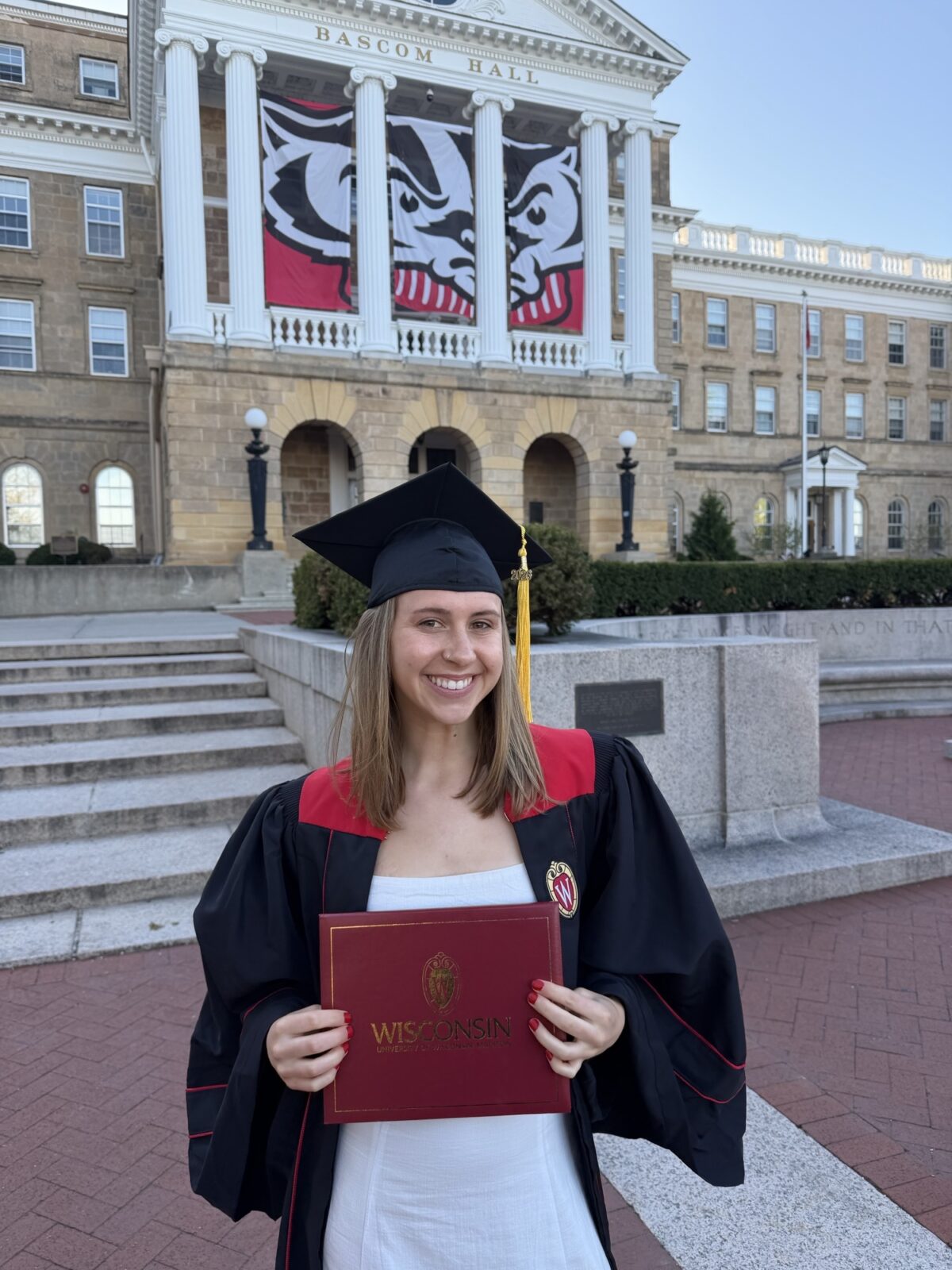
Elena Tomchek graduated UW–Madison in 2026 with a Biochemistry and Polish major.
About Hania
Hania Dahms is originally from Waterford, a small town in southeastern Wisconsin. At UW–Madison, she majored in International Studies and Education Policy Studies and completed a certificate in TESOL (Teaching English to Speakers of Other Languages). She has long been interested in languages and in how people learn and teach them. Since graduating in May 2025, she has been working as an ESOL instructor at an adult education organization near Boston, Massachusetts.
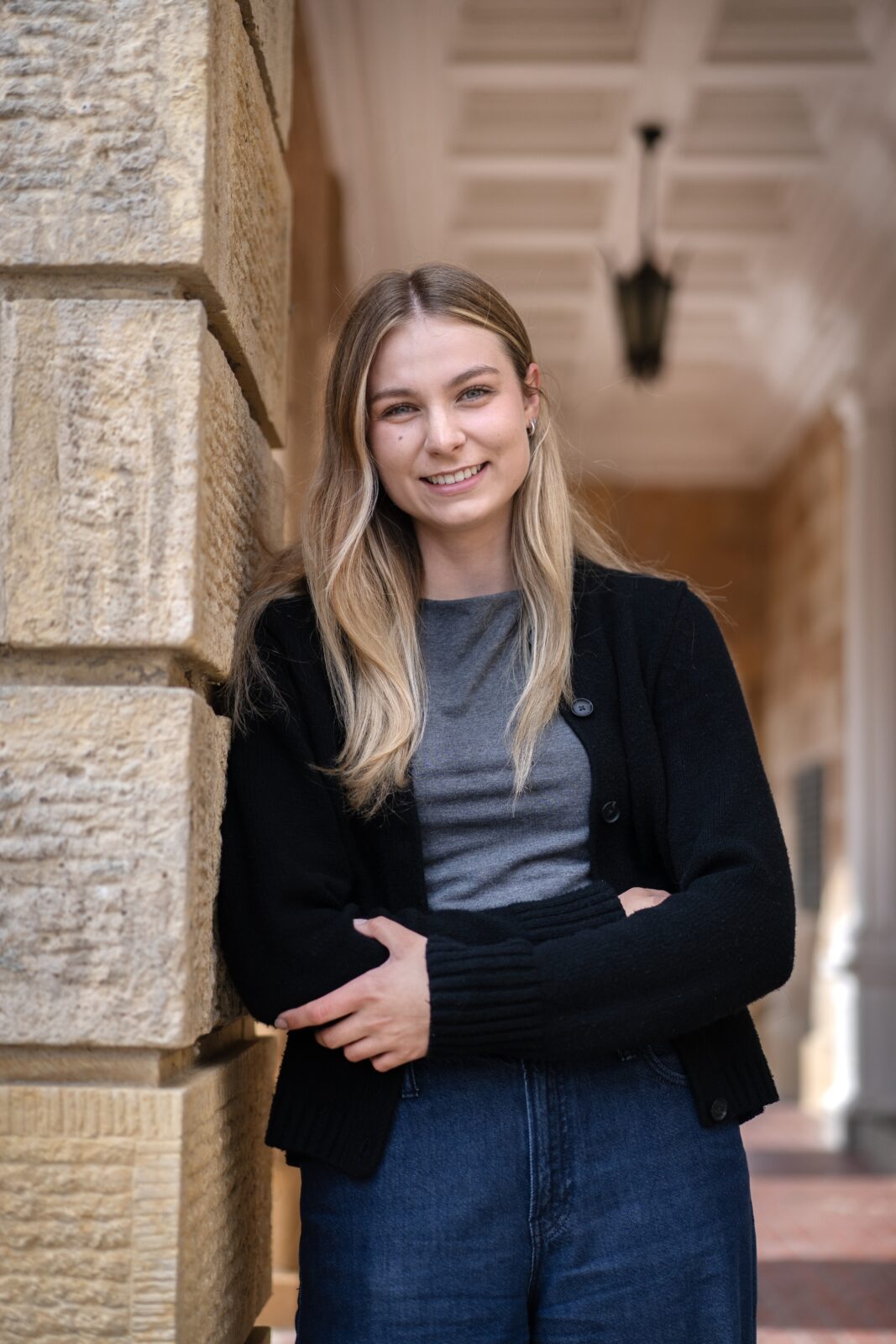
Hania Dahms took Polish language courses through the UW–Madison Polish Studies program.
Both Elena and Hania were also featured in a recent blog post from the UW International Division.
Read also:
Announcing 2026-2027 Polish Language, Literature, and Culture Awards
Celebrating Beyond the Horizon: Polish Culture Symposium
Announcing 2025 Madison Polish Film Festival
* * *
UW–Madison Polish Studies Program
Educating the Wisconsin public about the Polish language, literature, and culture since 1936.
The University of Wisconsin–Madison Polish Studies Program is the oldest academic program in the United States focused on the study and teaching of the Polish language, literature, and culture. UW–Madison Polish studies offer a comprehensive package of Polish language, literature, and culture courses, a generous scholarship program designed exclusively for its students, and various extracurricular activities each academic year.
The program, dating back to 1935, offers beginning, intermediate, and advanced Polish language courses, in addition to intensive Polish courses for heritage speakers and (under)graduate students. In 2011, the program received the prestigious 2022 Award Distinction from the University of Warsaw for its achievements in promoting the Polish language and knowledge about Polish culture and history. The UW–Madison Polish program also offers a broad range of Polish culture courses on Polish film, contemporary Polish culture, Polish migration to the Americas, a survey of Polish culture from the Middle Ages to modern times, Polish comedy culture, and post-communism.
Each year, the UW Polish program awards scholarships for tuition through the Lapinski fund to undergraduate and graduate students studying the Polish language, literature, and culture. The Polish Student Association (PSA) provides a space for all students interested in events, activities, and learning about Poland and Polish culture. In collaboration with the Polish program faculty, the PSA also co-organizes the Madison Polish Film Festival, an annual celebration of Polish cinematography in Madison, Wisconsin, now in its fourth decade of existence.