Scandinavian Studies Courses – Fall 2026
Featured Courses
(4 credits)
- Lecture 001: MTWR 9:55 – 10:45 am
- Lecture 002: MTWR 1:20 – 2:10 pm
Instructor: Ida Johnson
Course Description: This course introduces students to the Norwegian language through the skills of speaking, listening, reading, and writing. The course covers fundamental grammar concepts and topics including language and identity, education, food, and daily life. Instruction will emphasize communication and understanding as well as the intersections between language and culture.
Prerequisites: None.
(4 credits)
- Lecture 001: MTWR 12:05 – 12:55 pm
Instructor: Benjamin Mier-Cruz
Course Description: For beginning learners of Swedish; emphasis on proficiency through speaking, listening, reading, and writing, and on communication in cultural context.
Prerequisites: None.
(4 credits)
- Lecture 001: MTWR 12:05 – 12:55 pm
Instructor: Helen Durst
Course Description: This is an introductory course in basic Danish, so we will be working with the foundational skills of language acquisition, i.e. speaking, listening, reading, and writing. The most important aspect of learning a new language is using it, and we will base our strategy on the communicative language approach.
Prerequisites: None.
(4 credits)
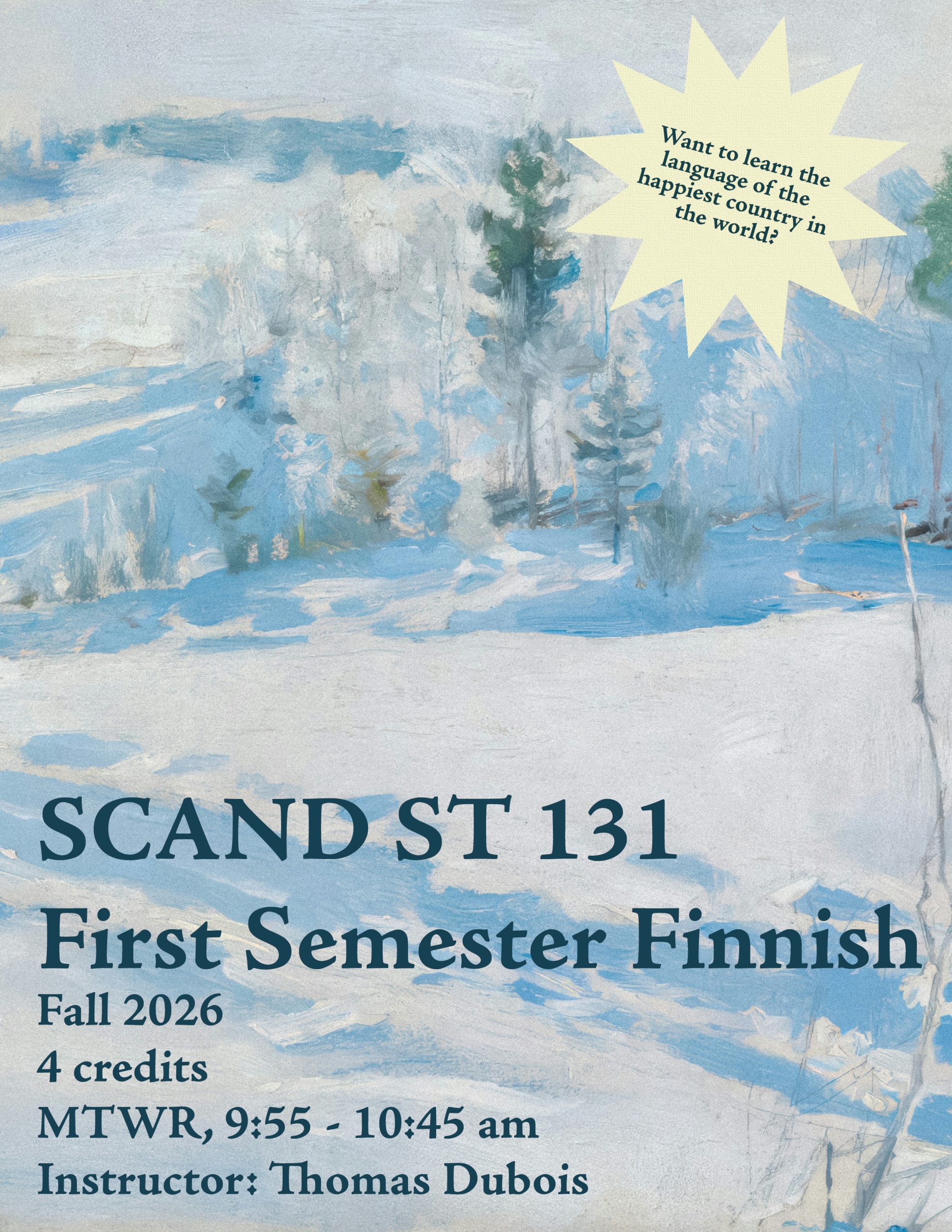
- Lecture 001: MTWR 9:55 – 10:45 am
Instructor: Thomas Dubois
Course Description: For beginning learners of Finnish; emphasis on proficiency through speaking, listening, reading, and writing, and on communication in cultural context.
Prerequisites: None.
(4 credits)
- Lecture 001: MTWR 11:00 – 11:50 am
Instructor: Ida Johnson
Course Description: In this intermediate Norwegian language course, students will complete the Sett i gang curriculum and read a novel. This course continues the language sequence’s focus on the core skills of speaking, listening, reading, and writing. Topics covered include work and economy, health and welfare, and advanced grammar skills. Instruction will emphasize communication and understanding as well as the intersections between language and culture.
Prerequisites: SCAND ST 102.
(4 credits)
- Lecture 001: MTWR 2:25 – 3:15 pm
Instructor: Helen Durst
Course Description: For mid-level learners of Danish; emphasis on proficiency in speaking, listening, reading, and writing, and on communication in cultural context, progressing from reading and conversing about concrete everyday topics to reading and conversing about increasingly abstract ideas. Readings of selections from Danish writers, grammar review and conversation.
Prerequisites: Scand St 122 (or approval)
(3 credits)
- Lecture 001: MW 2:30 – 3:45 pm
Instructor: Scott Mellor
Course Description: The World of the Sagas is a course that will give you an introduction to medieval Scandinavians and the Vikings and will help you explore Medieval and Scandinavian studies as fields as they relate to image and narrative. This course approaches medieval Scandinavia along historical lines, and its backbone is texts from medieval sources. However, most of us come to the topic of the medieval Norse, Scandinavians, or Vikings through gaming, movies, TV shows, or books which give us images and ideas of the people and era before we even reach the classroom. This class will start with those images and investigate where they come from and how they mould our lay ideas. We will then explore what scholars know and do not know about: the legendary history of early Scandinavia, the consolidation of the Scandinavian kingdoms, developments both at home and abroad during the great period of Viking expansion, and finally the conversion of the medieval Scandinavians to Christianity, which wrote finis to the Viking adventure. Within this historical framework, attention is devoted to the pre-Christian religion, to the system of writing – the celebrated runes, and the literature including the Icelandic sagas and the mythological and heroic poetry of the Eddas. As we learn about the medieval Scandinavians, we gain a greater understanding of ourselves and the human condition.
The Sagas of Icelanders;
Historical Atlas of the Vikings;
Jesse Byock’s The Prose Edda;
Jackson Crawford’s The Saga of the Volsungs.
Prerequisites: None
3 credits and part of a FIG
(3 credits)
- Lecture 001: TR 1:00 – 2:15 pm
Instructor: Dean Krouk
Course Description: Scand St 251 er en historisk innføring i norsk litteratur fra det moderne gjennombrudd (1870-1890) til etterkrigstiden (1945-1965). Vi leser et skuespill av Henrik Ibsen (Et dukkehjem, 1879) og en samling av kortere tekster (noveller og dikt), samt noen tekster av norske samtidsforfattere. Kurset inkluderer mye diskusjon og forutsetter aktiv deltakelse og kontinuerlig lesning av pensum gjennom hele semesteret.
Prerequisites: Scand St 202 or cons. inst.
(Taught in Norwegian)
(3 credits)
- Lecture 001: TR 1:00 – 2:15 pm
Instructor: Benjamin Mier-Cruz
Course Description: “Readings in Swedish Literature” is both a language course and a literature course. Students should have the equivalent of two years of Swedish language and the course counts as a fifth-semester language course. We will be reading and discussing short literary texts from the 19th and 20th Centuries. All instruction is conducted in Swedish and students will improve their speaking, listening, reading, and writing skills. Required assignments include papers, translations, and presentations. Course readings will be provided.
Prerequisites: SCAND ST 212 or consent of instructor.
(3 credits)
- Lecture 001: TR 11:00 am – 12:15 pm
Instructor: Claus Andersen
Course Description: This class will help you to become even better at speaking, writing, reading, and listening to Danish.We will read authentic Danish texts and discuss current issues to help expand your knowledge and understanding of Danish.
Prerequisites: SCAND ST 222.
(4 credits)
- Lecture 001: MTWR 8:50 – 9:40 am
- Lecture 002: MTWR 1:20 – 2:10 pm
Instructor: Ida Johnson
Course Description: This course introduces students to the Norwegian language through the skills of speaking, listening, reading, and writing. The course covers fundamental grammar concepts and topics including language and identity, education, food, and daily life. Instruction will emphasize communication and understanding as well as the intersections between language and culture.
Prerequisites: Graduate standing.
(4 credits)
- Lecture 001: MTWR 12:05 – 12:55 pm
Instructor: Helen Durst
Course Description: This is an introductory course in basic Danish, so we will be working with the foundational skills of language acquisition, i.e. speaking, listening, reading, and writing. The most important aspect of learning a new language is using it, and we will base our strategy on the communicative language approach.
Prerequisites: Graduate standing.
(3 credits)
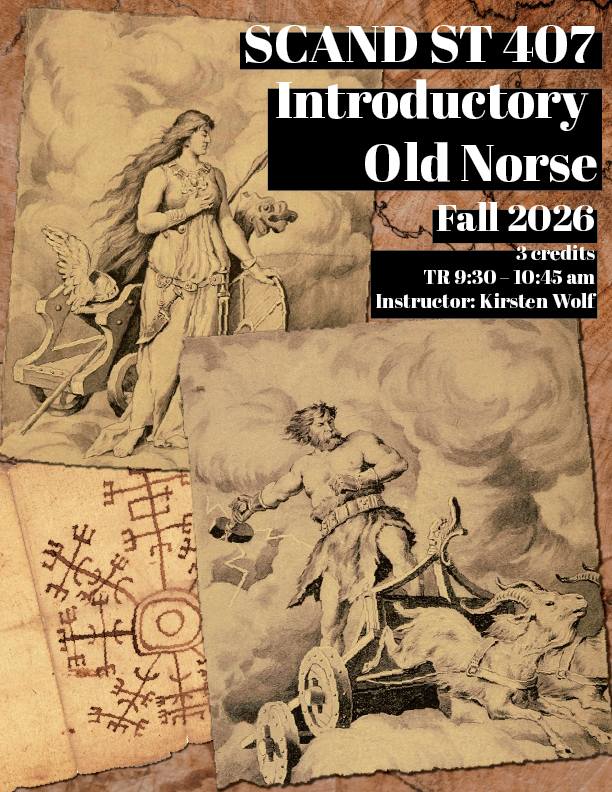
- Lecture 001: TR 9:30 – 10:45 am
Instructor: Kirsten Wolf
Course Description: Objectives: The course has a linguistic purpose and is designed to give students a reading knowledge of Old Norse through the study of Old Icelandic grammar and selections of Old Norse-Icelandic texts.
Content: The course begins with with an introduction of Old Icelandic grammar through the study of Kenneth G. Chapman’s Graded Readings and Exercises in Old Icelandic. Next, students move to Michael Barnes’ A New Introduction to Old Norse. Part I: Grammer. At the same time, students read, translate, and analyze a selection of literary texts in Anthony Faulkes’ A New Introduction to Old Norse. Part II: Reader with the help of Part III: Glossary and Index of Names.
Learning outcomes: By the end of the course, students will have a basic understanding of Icelandic phonology and grammar with a focus on nominal and verbal inflection. (For a more in-depth understanding of verbal inflection and also syntax, it is recommended that students move on to 408 Old Norse II). Students will have sufficient vocabulary to be able to read and understand basic texts in normalized editions and access more challenging texts with the help of a dictionary.
(3 credits)
- Lecture 001: TR 9:30 – 10:45 am
Instructor: Kirsten Wolf
Course Description: The course is intended to give students an overview of Old Norse-Icelandic literature from the earliest times until the Reformation in the mid-sixteenth century. It seeks to familiarize students with the vast body of Old Norse-Icelandic literature through a chronological study of the major literary genres: eddic poetry, skaldic poetry, religious literature (homilies, saints‘ lives, biblical translations), early historical writings, contemporary sagas (bishops‘ sagas and Sturlunga saga), sagas of Icelanders, mythical-heroic sagas, romances, and rímur). Representative texts from each genre will be read and analyzed in class.
Prerequisites: The course is a continuation of 407 and 408 and requires familiarity with Old Norse-Icelandic grammar and a reading knowledge of Old Norse-Icelandic.
(1 credit)
- Lecture 001: W 4:00 – 4:50 pm
Instructors: Scott Mellor and Helen Durst
Course Description: Concentrated study of topics within Scandinavian literature.
Prerequisites: 5 semesters or equivalent of Scandinavian language.
(3 credits)
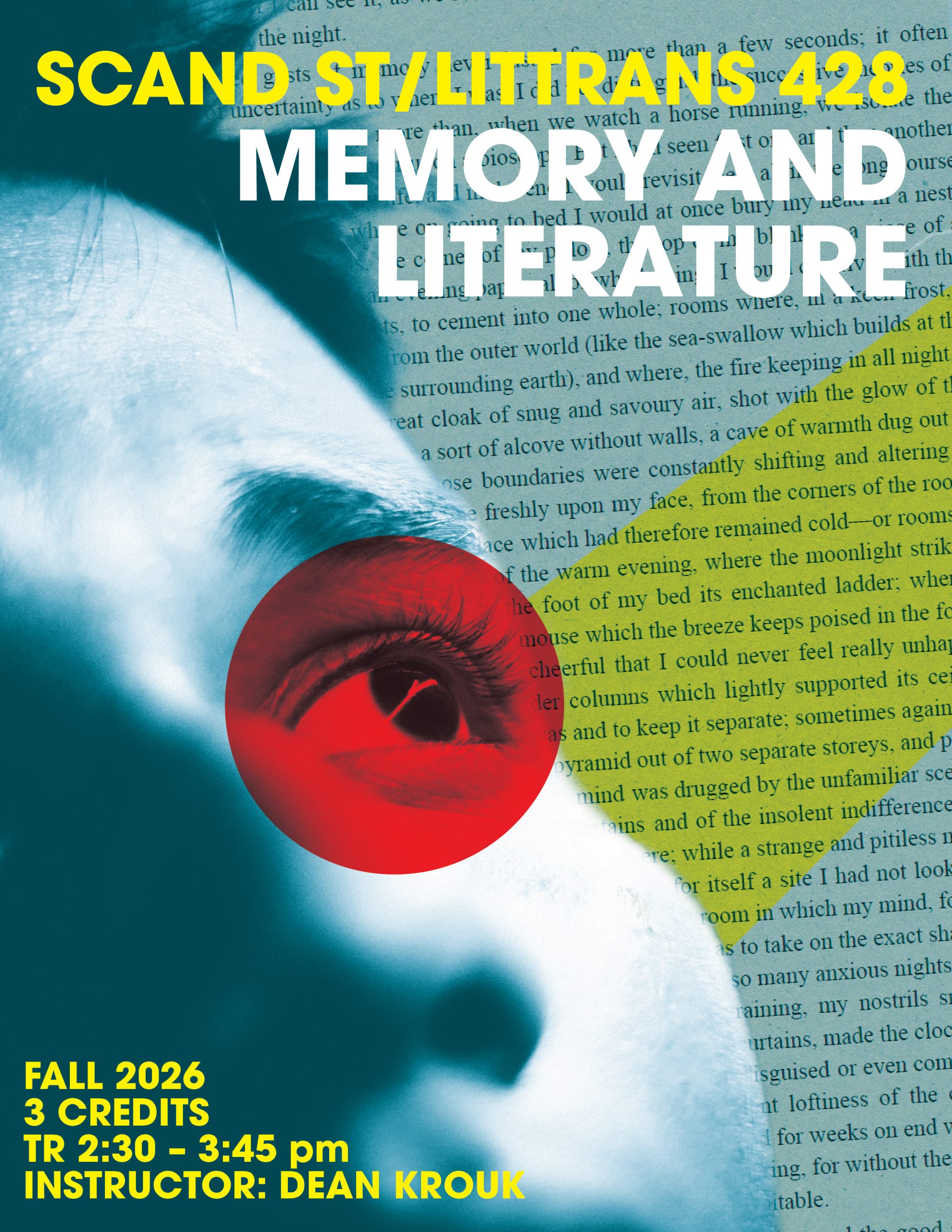
- Seminar 001: TR 2:30 – 3:45 pm
Instructor: Dean Krouk
Course Description: Investigates the relations between theories of memory, both individual and collective, and modern literary representations of remembering. Survey seminal conceptions of memory in the interdisciplinary field of memory studies, investigating topics such as nostalgia, trauma, personal and cultural identity, war and Holocaust, sites of memory, and autobiographical narrative. Through the avenues opened up by these theoretical frameworks, consider the narrative forms as well as the ethical and political dimensions of remembering in works of fiction from the twentieth and twenty-first centuries.
Prerequisites: Sophomore standing
Also listed as LIT TRANS 428.
(3 credits)
- Lecture 001: TR 2:30 – 3:45 pm
Instructor: Scott Mellor
Course Description: Myths and images of Vikings are everywhere, but what was really going on in Scandinavia during the Viking Age (750-1150) and what happened in the Nordic countries between the Viking Age and the nineteenth century. This course surveys Scandinavian history up to 1815. You will learn not only about medieval Scandinavia and the founding of the Scandinavian Kingdoms, but also about the fascinating changes in Northern Europe during the Reformation, the Age of the Scandinavian Empires, the Enlightenment, and the beginning of the move from Kingdoms to nation states.
Prerequisites: Sophomore Standing
Breadth – Either Humanities or Social Science
Level – Advanced
L&S Credit – Counts as Liberal Arts and Science credit in L&S
Grad 50% – Counts toward 50% graduate coursework requirement
(3 credits)
- Lecture 001: TR 4:00 – 5:15 pm
Instructor: Thomas Dubois
(3 credits)
- Seminar 001: M 2:25 – 5:00 pm
Instructor: Ida Moen Johnson
Course Description: What is a child, and why do children figure so prominently in Nordic texts and cultures? How have scholars defined and troubled the notion of childhood innocence, and what ethical and cultural value, if any, does the category of innocence retain? What are the limits of the “Nordic autonomous child’s” agency, in texts and in the world? These are among the questions we examine in this graduate seminar, which takes up fiction, film, history, and theory in addressing a wide range of Nordic child figures across time. We start with Pippi Longstocking–the archetype of the Nordic autonomous child–then move chronologically from the 19th to the 21st century. By the end of the course, you should have an informed understanding of key questions within childhood studies, an expanded knowledge of Scandinavian literature and film, and make concrete, meaningful connections to your own research. In addition to producing a seminar paper, students will complete regular lower-stakes assignments to build discrete skills in scholarly writing.