Folklore Courses – Fall 2026
Featured Courses
(3 credits)
- Lecture 001: TR 2:25 – 3:15 pm
- Discussion 301: W 8:50 – 9:40 am
- Discussion 302: W 3:30 – 4:20 pm
- Discussion 303: R 8:50 – 9:40 am
- Discussion 304: R 9:55 – 10:45 am
- Discussion 305: F 8:50 – 9:40 am
- Discussion 306: F 3:30 – 4:20 pm
- Discussion 307: W 2:25 – 3:15 pm
- Discussion 308: F 9:55 – 10:45 am
- Discussion 309 : M 4:35 – 5:25 pm
- Discussion 310: T 7:45 – 8:35 am
- Discussion 311: R 8:50 – 9:40 am
- Discussion 312: R 9:55 – 10:45 am
Instructor: Lowell Brower
Course Description: This course serves as an introduction to folklore; that is, the arts, beliefs, stories, sayings, customs, and ways of communication we engage with in our everyday lives. We’ll be examining a variety of folklore genres, while also learning about and employing the methods and practices of folklore scholars. Because this is a practical as well as theoretical course, we will be conducting fieldwork in the region as part of a semester-long folklore project. By the end of the term, you will be able to better understand what folklore is, how and why it functions, and the many and often hidden ways that it is a part of our everyday lives. You’ll learn about ethnographic methods and techniques and how to use interviews, photography, and videography to document various genres of folklore. You’ll better understand what culture is, how it affects our everyday lives, and how it is transmitted, changed, created and re-created, lost, found, and reclaimed.
(3 credits)
- Lecture 001: MW 11:00 – 11:50 am
- Discussion 301: M 8:50 – 9:40 am
- Discussion 302: M 1:20 – 2:10 pm
- Discussion 303: W 2:25 – 3:15 pm
- Discussion 304: T 8:50 – 9:40 am
- Discussion 305: W 4:35 – 5:25 pm
- Lecture 002: TR 11:00 – 11:50 am
- Discussion 301: M 8:50 – 9:40 am
- Discussion 302: M 1:20 – 2:10 pm
- Discussion 303: W 2:25 – 3:15 pm
- Discussion 304: T 8:50 – 9:40 am
- Discussion 305: W 4:35 – 5:25 pm
Course Description: General understanding of humans in relation to cultures, evolutionary development and racial diversity, capacities for society, and the development of the world’s major cultures.
(3 credits)
- Lecture 001: MW 11:00 – 11:50
- Discussion 301: W 12:05 – 12:55 pm
- Discussion 302: W 1:20 – 2:10 pm
- Discussion 303: W 2:55 – 3:15 pm
- Discussion 304: R 9:55 – 10:45 am
- Discussion 305: R 11:00 – 11:50 am
- Discussion 306: R 12:05 – 12:55 pm
- Discussion 307: F 8:50 – 9:40 am
- Discussion 308: F 9:55 – 10:45 am
- Discussion 309 : F 11:00 – 11:50 am
Course Description: Introduction to comparative ethnic studies, examining race, ethnicity, and indigeneity within the United States.
(3 credits)
- Online Only
Course Description: The oral tradition and the written word; the composition of stories, relationship between performer and audience, and transmission of tradition in various African societies.
(3 credits)
- Lecture 001: TR 4:00 – 5:15 pm
Instructor: Jason Schroeder
(3 credits)
- Lecture 001: MW 2:30 – 3:45 pm
Instructor: Scott Mellor
Course Description: The World of the Sagas is a course that will give you an introduction to medieval Scandinavians and the Vikings and will help you explore Medieval and Scandinavian studies as fields as they relate to image and narrative. This course approaches medieval Scandinavia along historical lines, and its backbone is texts from medieval sources. However, most of us come to the topic of the medieval Norse, Scandinavians, or Vikings through gaming, movies, TV shows, or books which give us images and ideas of the people and era before we even reach the classroom. This class will start with those images and investigate where they come from and how they mould our lay ideas. We will then explore what scholars know and do not know about: the legendary history of early Scandinavia, the consolidation of the Scandinavian kingdoms, developments both at home and abroad during the great period of Viking expansion, and finally the conversion of the medieval Scandinavians to Christianity, which wrote finis to the Viking adventure. Within this historical framework, attention is devoted to the pre-Christian religion, to the system of writing – the celebrated runes, and the literature including the Icelandic sagas and the mythological and heroic poetry of the Eddas. As we learn about the medieval Scandinavians, we gain a greater understanding of ourselves and the human condition.
The Sagas of Icelanders;
Historical Atlas of the Vikings;
Jesse Byock’s The Prose Edda;
Jackson Crawford’s The Saga of the Volsungs.
Prerequisites: None
3 credits and part of a FIG
(3 credits)
- Lecture 001: TR 1:00 – 2:15 pm
Instructor: Anna Rue
(3 credits)
- Lecture 001: W 5:45 – 8:15 pm
Instructor: Lowell Brower
Course Description: What do our ghost stories say about us, what do our beasts betray about us? Which witches bewitch us, which rumors consume us, and what sense can be made of what haunts us? Restless spirits, alien invaders, wicked witches, bloodthirsty vampires, legendary cryptids, murderous ogres, Illuminati satanists, deep-state conspirators, memetic online menaces: our contemporary bestiary is overflowing with meaningful monsters. Our spine-tingling intellectual task in this course will be to analyze the roles that these malevolent entities and the supernatural narratives we tell about them play in our everyday lives, our collective psyches, our communities, our politics, and in the crises we confront as individuals and groups. Are our occult stories allegories of our modern discontents, or simply holdovers from our childhood nightmares? Are they symptoms of specific societal crises, or representations of timeless pan-human fears? How has the witch hunt, the rumor panic, the “standardized nightmare of the group” transformed in this meme-ified age of online participatory culture, global interconnection, ecological catastrophe, and fake-news-driven conspiracy thinking? What can we learn about ourselves, our pasts, and our futures by thinking deeply about what scares us the most? And how frightened should we be of what we might find if we dig too deeply into that question?
While trembling together in the creepiest classroom on campus, we will analyze “the supernatural” in relation to historical memories, cultural anxieties, folk traditions, spiritual beliefs, physiological sensations, political conflicts, environmental disasters, existential imperatives, and just about everything else under the moon. Because nowhere is safe from the things that go bump in the night, our interdisciplinary journey will take us across time and space into the bellies of various beasts, from the stacks of Memorial Library, to the hills of Rwanda, to the message boards of 4chan, to the proms of rural Pennsylvania, to the ships of the Middle Passage, to the villages of medieval Europe, to the halls of the White House, to your creepy neighbor’s basement, to the deep dark woods.
Our abominable assignments will include creative reading responses, the documentation and analysis of frightful folklore, a fearsome final project, and a co-created creepy campus tour. Course activities may include local excursions, storytelling sessions, and paranormal experimentation. Enroll if you dare.
Prerequisites: Junior standing.
(3 credits)
- Lecture 001: TR 1:00 – 2:15 pm
Instructor: Langston Collin Wilkins
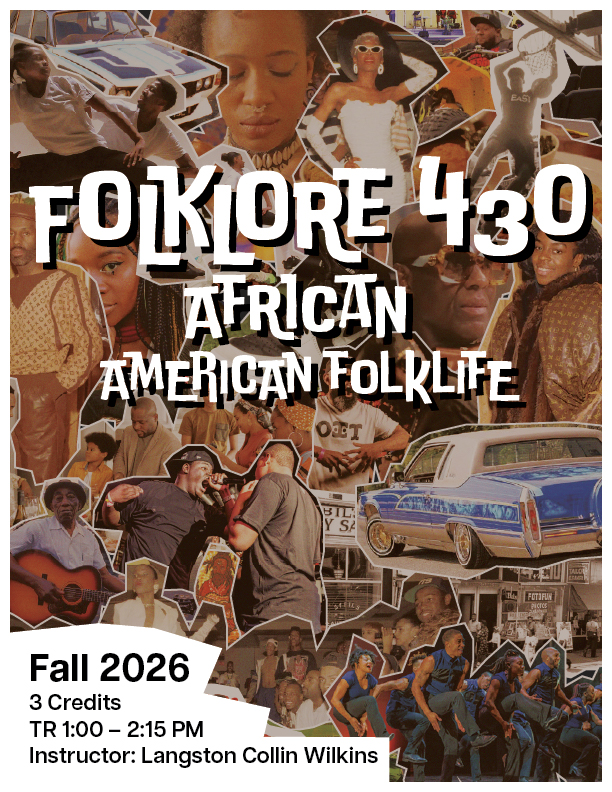
Course Description: This course examines post-civil rights era urban African American folklife from across the United States. Each week, we will explore spaces and places of African American folk production, focusing on multiple genres of expression. Class discussions will interrogate the ways in which these selected folk practices build upon earlier forms, their complex relationships with each other, and their function within the communities of origin. We will also critically examine how these practices intersect with important societal phenomenon- namely issues of race, class, gender, power, and migration. In addition, students will conduct ethnographic fieldwork project and produce media related to African American folklife in Wisconsin. The goal of this course is to use the lens of African American folklife to gain a better understanding of the dynamic and multi-faceted nature of contemporary African American life in general.
Prerequisites: Sophomore standing.
(4 credits)
- Lecture 001: TR 4:00 – 5:15 pm
Instructor: Thomas Dubois
Course Description: Interdisciplinary study of Sami (Lapp) people of Scandinavia past and present. Indigenous modes of expression and worldview, contemporary cultural and political activism. Extensive discussion of connections to Native American and Inuit experiences; rise of U.S. and other indigenous peoples’ movements.
Prerequisites: Junior Standing
(Breadth: Humanities or Social Science. L&S credit type: counts as LAS credit (L&S). General education: ethnic studies.)
(3 credits)
- Lecture 001: R 3:30 – 6:00 pm
Instructor: Langston Collin Wilkins
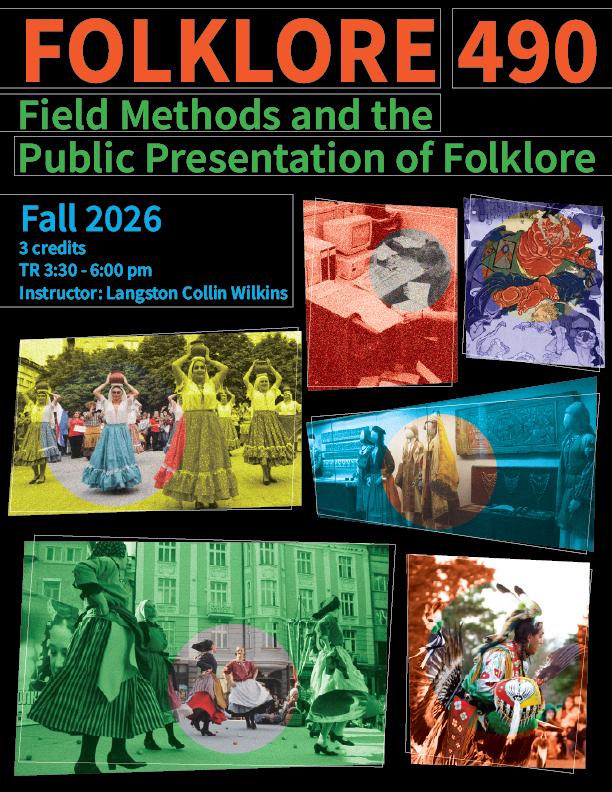
Course Description: This course is an immersive exploration of public and applied folklore practice. Course material and activities will focus on the cultural, political, and ethical dimensions underlying the documentation and public presentation of folklore through festivals, exhibitions, publications, audio-visual productions, and digital archival collections. Students will conduct fieldwork, produce media, and develop programming meant for public engagement.
Prerequisites: Sophomore Standing
(3 credits)
- Lecture 001: TR 8:00 – 9:15 am
Instructor: Nadia Chana
(3 credits)
- Lecture 001: TR 11:00 – 12:15 pm
Instructor: Scott Mellor
Course Description: This interdisciplinary course explores the rich tapestry of Nordic mythology, folklore, and cultural narratives through the lens of game design and analysis. Students will investigate how historical and mythological elements are adapted into interactive media, with a focus on storytelling, symbolism, and visual culture in games. Drawing from narrative theory, image theory, and game studies, students will critically analyze and creatively apply these frameworks to craft compelling game concepts rooted in Nordic traditions. This course is ideal for students in folklore, media studies, game design, literature, and cultural studies who are interested in the intersection of myth, storytelling, and interactive media.
Prerequisites: Junior Standing
Level – Advanced
L&S Credit – Counts as Liberal Arts and Science credit in L&S
(3 credits)
- Seminar 001: T 4:00 – 6:30 pm
Instructor: Leonie Schulte
Course Description: Theoretical and practical aspects of ethnographic research; history of field research in anthropology; research design issues; writing proposals; the fieldwork experience; methods of field data collection; ethical issues; data interpretation and analysis; writing ethnography.
(3 credits)
- Seminar 001: W 1:00 – 3:30 pm
Instructor: Falina Enriquez
Course Description: Graduate Seminar (open to undergraduate students) geared toward professional development. In this seminar we will largely be working with ongoing and proposed research projects and turning these into conference papers. Throughout the semester, students will learn how to write abstracts, conference scripts, and present their research, practicing public speaking skills and engaging with interdisciplinary audiences. We will also center themes of translation, representation of research materials and working with ethnographic vignettes.
(3 credits)
- Seminar 002: M 12:45 – 3:15 pm
Instructor: Leonie Schulte
Course Description: Graduate Seminar (open to undergraduate students) geared toward professional development. In this seminar we will largely be working with ongoing and proposed research projects and turning these into conference papers. Throughout the semester, students will learn how to write abstracts, conference scripts, and present their research, practicing public speaking skills and engaging with interdisciplinary audiences. We will also center themes of translation, representation of research materials and working with ethnographic vignettes.