Folklore Courses Spring 2023
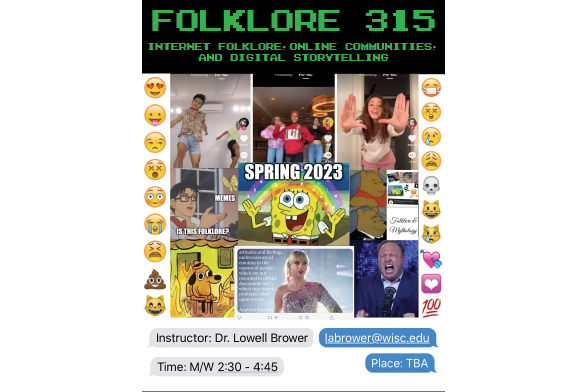
FOLKLORE 315
Internet Folklore, Online Communities, and Digital Storytelling
(3 credits)
TR 3:30 – 4:20 pm (+ discussion section) Instructor: Lowell Brower
Course Description: This course serves as an introduction to folklore; that is, the arts, beliefs, stories, sayings, customs, and ways of communication we engage with in our everyday lives. We’ll be examining a variety of folklore genres, while also learning about and employing the methods and practices of folklore scholars. Because this is a practical as well as theoretical course, we will be conducting fieldwork in the region as part of a semester-long folklore project. By the end of the term, you will be able to better understand what folklore is, how and why it functions, and the many and often hidden ways that it is a part of our everyday lives. You’ll learn about ethnographic methods and techniques and how to use interviews, photography, and videography to document various genres of folklore. You’ll better understand what culture is, how it affects our everyday lives, and how it is transmitted, changed, created and re-created, lost, found, and reclaimed.
MW 4:00-4:50 pm Instructor: Morgan Smallwood
MW 9:55-10:45 am Instructor: Lucille Mok
This class is online.
(3 credits)
TR 11:00 am – 12:15 pm Instructor: Scott Mellor
Course Description: Horror has been a popular genre of storytelling since time immemorial. The horror expressed in story is often representative of fear and anxiety, sometimes personal, other times more representative of our communities. Through the oral tradition, we tell ghost stories, abduction stories and more to express the angst we feel the world around us. Since the advent of the novel, those fears have found their way into our literature and more recently our movies, television shows and more. This course will look at representations of social angst as they express themselves in horror stories, mostly in a European and North American context. In this class is will look social issues expressed in horror. Students will have an opportunity to express their opinions about the social issues expressed in the horror movies, synthesize, and relate them to their experiences outside the classroom through class discussion and weekly written discussions.
Prerequisites: Open to first-year students.
(3 credits)
MW 2:30 – 3:45 pm Instructor: Lowell Brower
Course Description: That subversive meme just posted to UW Madison Memes for Milk-Chugging Teens…that contemporary legend circulating on the creepypasta Wiki…that TikTok dance craze you just tried…that infuriating “fake news” your uncle keeps amplifying on Facebook…that 4-Chan board that you wish you hadn’t read…your frenemy’s latest Instagram post: all of these and more comprise our consequential objects of study in this course. Exploring the wild world wide web of informal vernacular culture being created, transmitted, and adapted by online communities, this course examines the powers, potentials, and peculiarities of internet folklore in relationship to community-building, political engagement, social change, and everyday negotiations of individual and group identity. On our digital journey, we encounter viral videos, meme warriors, urban legends, occult folk beliefs, disinformation campaigns, and viral challenges, while examining connections between contemporary online culture and ancient storytelling traditions. What new folk groups, storytelling genres, and political potentialities are arising as a result of online engagement? What are the creative, destructive, and ambivalent capacities of online participatory culture, and how are they being harnessed in projects of future-making? Course assignments invite students to research, analyze, and participate in digital storytelling in an attempt to better understand ourselves and our historical moment through folkloristic engagement.
(3 credits)
MW 2:25-4:05 pm Instructor: Peggy Choy
(3 credits)
TR 2:30 – 3:45 pm Instructor: Benjamin Mier-Cruz
Course Description: This course explores the historical development of the vampire legend from the 18th century until today, with particular attention to literary works, film, and television. The course will additionally focus on representations of gender and sexuality related to the vampire.
(3 credits)
TR 1:00 – 2:15 pm Instructor: Scott Mellor
Course Description: Telling stories is as old as time. Folk storytelling, which originate in the distant past, has often been scorned by the literary establishment, but the fact that they survived through centuries of oral transmission until they were finally recorded in the fairly recent past testifies to their lasting existential appeal. The stories these texts tell are dashingly entertaining and often deeply disturbing: they may offer a profoundly fatalistic view of existence, but they may also voice an angry and, at the same time, humorous protest against oppression. When this narrative type was discovered by scholars and the societal elite about 1800, it inspired many first-rank Nordic authors, e.g., Hans Christian Andersen, Henrik Ibsen, Selma Lagerlöf; and in the 20th century it has cast its spell over Isak Dinesen, Villy Sørensen, and Pär Lagerkvist and its influence has moved from literary to other media today. The course examines both the original folktales, its modern “imitations” and literature as well as gives an introduction to the critical methodologies that have recently been developed to deal with this seemingly simple, but in reality, highly sophisticated, narrative.
Prerequisites: Sophomore or higher
(3 credits)
TR 11:00 am – 12:15 pm Instructor: Amber R. Cederström
Course Description: This course examines legends and conspiracies in Western Europe and North America from the medieval period to the present day. Related vernacular expressions like rumors, rumor panics, and folk belief will also be discussed. Some experience with folklore courses is useful but not required. The course will focus particularly on narratives about diabolic activities and threats to children, with an emphasis on the durability of conspiratorial and legendry beliefs. Students should be prepared to read about and discuss extremely distressing topics, including sexual assault, torture, child abuse, antisemitism, misogyny, and so on, situated in particular cultural and historical contexts. Respect and patience will be paramount. By the end of the semester, students should have a solid theoretical understanding of legends and conspiracy theories and be able to effectively analyze them in their social and cultural contexts.
Prerequisites: Junior standing
(Repeatable for credit)
(3 credits)
MW 3:00 – 5:15 pm Instructor: Langston Collin Wilkins
Course Description: This course examines post-civil rights era urban African American folklife from across the United States. Each week, we will explore spaces and places of African American folk production, focusing on multiple genres of expression. Class discussions will interrogate the ways in which these selected folk practices build upon earlier forms, their complex relationships with each other, and their function within the communities of origin. We will also critically examine how these practices intersect with important societal phenomenon- namely issues of race, class, gender, power, and migration. The goal of this course is to use the lens of African American folklife to gain a better understanding of the dynamic and multi-faceted nature of contemporary African American life in general.
(3 credits)
TR 8:00 – 9:15 Instructor: James Walsh